What’s the difference between Craniosacral Therapy and Reiki Healing
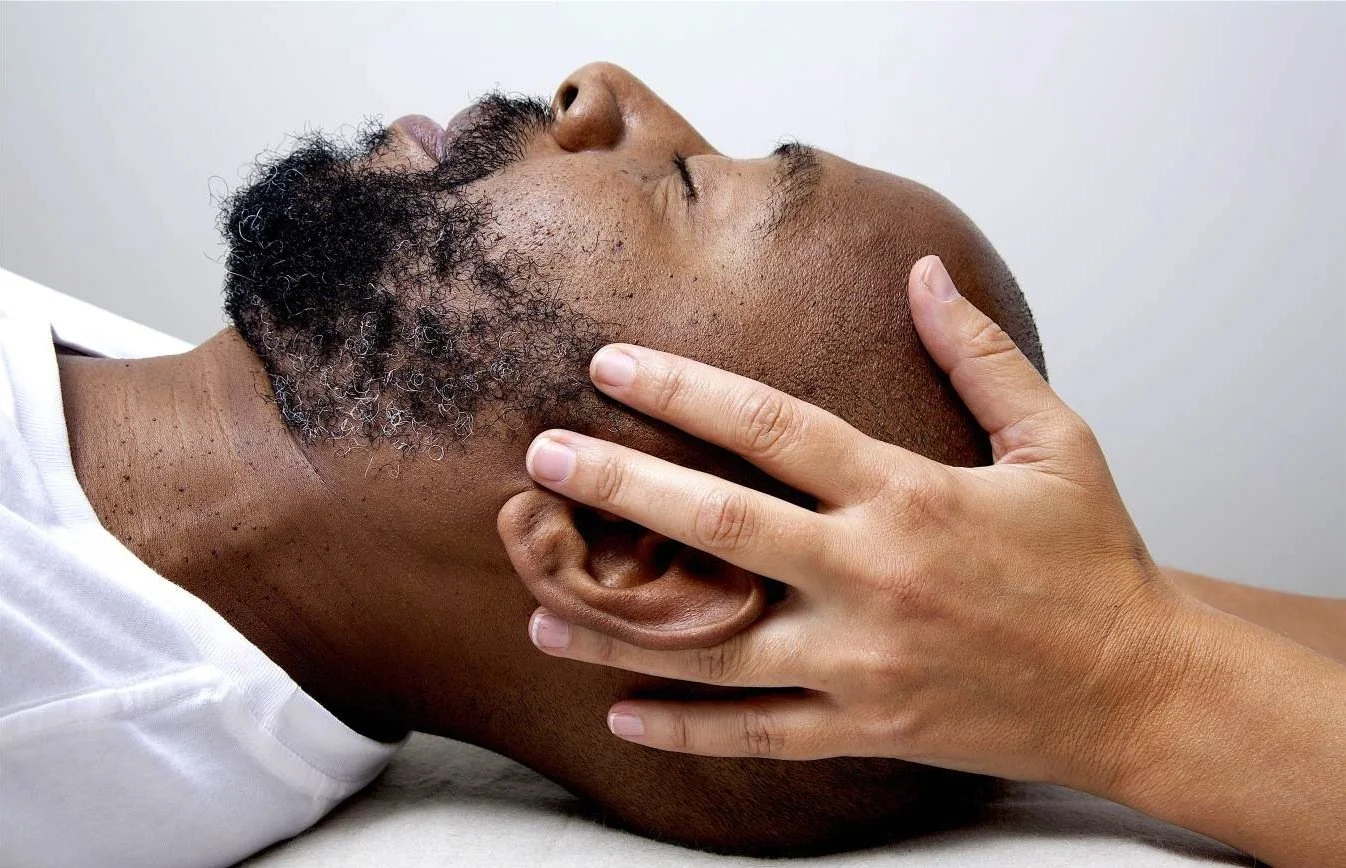
If you came in to have a treatment with me, you would likely experience, for example, hands gently holding the back of your head.. ...so does it matter if it's Reiki or CranioSacral treatment, " IT LOOKS THE SAME " so it is the same, right?
This article sets out how and why these two powerful treatment modalities are very different, their differing principals that underpin each of these treatment modality, and the difference of healing experience you might encounter.
If you are not familiar with these treatments then please description on my website for Reiki
or for external description Reiki Association https://www.reikiassociation.net/what-is-reiki.php
For Craniosacral description on my website
or external description by the Craniosacral Therapy Association http://www.craniosacral.co.uk/craniosacral-therapy
So, when I ask you which treatment you would like, you can be confident that you have selected the treatment that suits you the best!
Principles of Reiki
A Reiki healer's role is to act as a kind of "conduit" for Universal Life Force (aka Rei-Ki) and this passes through to the client, through gentle hand contact on the body. The touch allows for a different energy vibration inside the body that acts like a catalyst for the healing process.
The healer's ability to channel Universal energy is enhanced after receiving the teachings and been initiated by their Reiki Master. The Initiation process is similar to tunning the healer into a radio frequency that facilitates the practitioners frequencies for even more effective healing. There is no academic training.
Hands are lightly * placed in various positions on the top of a fully clothed body. The positions flow from head towards the feet. Half way through the treatment, the client is asked to turn over and faces downwards, and treatment hand positions follow down the body.
The Reiki Healer does not draw on any palpation (energy, tone, tension, motion patterns in the body) skills, they may or may not have.
The Reiki Healer trusts that the Reiki energy is intelligent and will provide mind, body and spirit with exactly what the client needs for that moment in time.
The body helps to communicate with the healer when it is time to move on to the next position. Treatments are completed within the hour.
The Reiki Healer may draw SACRED symbols in the air to bring an extra healing dimension to the treatment - according to clients needs.
Sometimes clients report that they do NOT feel any sensations of reiki energy. Perceptual skills are so variable, even within the same individual over time. Even if you can't perceive much, be confident that healing energy within the body is working. The Universal healing energy affects the mind, body and spirit.
In Reiki your body will receive ONLY as much energy as your mind and body is able to handle. We think we might like to receive a "one-time-miracle-cure" for a chronic problem, and Reiki is powerful enough to do this, however, the mind and body adjusts the receiving and integration according to what feels safe for the client, so as not to overwhelm them. Alot of power and huge abrupt changes are difficult to integrate!
In Reiki you are protected from any 'misqualified' energies that might reside in your Reiki Healer. Even in the unlikely event that they are holding some 'baggage' or some negative emotional state, this cannot be passed on, into the client by touch, only the Reiki Universal energy passes.
* There are various lineages of Reiki, and some are hands off the body mode. Check with your Practitioner, and ask for the mode you prefer!
Principals of Craniosacral Therapy
Unlike the Reiki Healer who completes a short course and initiation process, the qualified Craniosacral therapist will have undertaken a minimum of 100 hours of Anatomy, Physiology and Pathology study followed by a two year's vocational training. Following qualification, Craniosacral therapists continue to adhere to the ethics and integrity of the membership association (CSTA) and obtain full professional insurance for working with the public. There is no requirement to be affiliated to any Reiki Association or their guidelines. Craniosacral therapists undertake continuous professional development and are encouraged to receive regular supervision. Craniosacral therapists undertake a case history with new clients to help them understand; patterns and history of symptoms, early experience that impact on health and information that would indicate treatment adjustments for safety.
Resonance and the relationship between Craniosacral therapist and client are powerful territories which are necessary prerequisites for treatment outcomes.
Depending on the training of the practitioner** they may invite a discussion with the client about their resource and positive 'felt sensory tones' in the body. During the treatments, this resource may be referred to again if something arises that has the potential for making the client feel re-traumatised by a memory. Resources is like an internalised sense of safety and is so important for the client when working with trauma and is vital for bringing about a healing resolution rather than "re-doing" the trauma itself!
Beginning at the side of the table, the practitioner draws on mindfulness presence for their clients to help them settle - it creates a field of safety. This is followed by initial contact at the feet, a gentle way to help the client's system to deepen and settle further. The client's system shifts out of vigilance, stress and fragmentated states into a deep relaxed state. The Practitioner always orientates to the health of the mind-body system.
Unlike Reiki, the Practitioner invites dialogue about what is being felt in the body. The client is encourage to share, in real PRESENT time, sensations, thoughts, feelings, memories, visuals, colours etc., this not only allows for the resolution of 'conditional forces' that has happened, it also integrates the process between mind, body and spirit. In Reiki, the client chooses if and when to share and the Practitioner follows their lead.
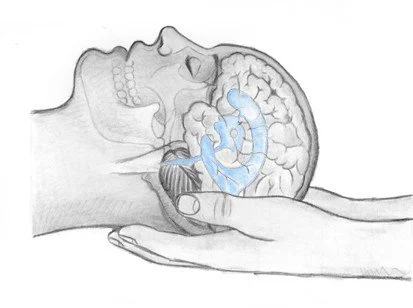
Contact holds are generally made from the underside of the body (unlike reiki which is from top), especially so in various places along the spine and the sides of the head. The client never lies face downwards on the couch. However, the client may be invited onto their side for a combined sacral/occipital hold. This is very integrative and very feels very supportive.
Craniosacral therapists 'listen' to the body and what it wants to be acknowledged; and often will guide the practitioner on areas to be in contact with. Unlike Reiki, there is no protocol to be followed for complete set of contact 'holds', nor is there a time limit placed on a specific hold. It could be that the whole session could be from, say, Sacral hold, as this was what was needed! The body's Intelligence (yes, I did mean it with a capital I) decides which order to resolve these 'issues' held in the body. Think of a knotted ball of wool, the Intelligence knows which 'knot' to deal with, and knows which order move through to get to the ones in the centre without knitting up more 'knots' in the process..!
Craniosacral therapists are guided by the body's Intelligence to the area of tissue densification, of stuck energy in the body. When in more local contact, the Practitioner, uses very subtle augmentation skills to help bring things into balance, allowing the area to release the source of the problem. The stuck energy is freed in the body, increasing vitality. Sometimes, there may be an emotional trauma linked to this 'densification'. Should this arise, the practitioners uses specialised verbal skills, and the client is reminded of their resources to help transform their history and their body's emotional expression of that, towards a safe and calm resolution. The freed energy is further integrated and there is a sense of more coherence and wholeness of the person.
Highly traumatised clients who can't access their good felt sense of 'resources' in their body or life support easily - or easily become disconnected from their own bodies e.g numbness, spaced out, not "here", may initially have slow progress towards physical healing until sufficient resources available to keep the body safe from re-traumatisiation. As healing occurs over time, more and more resources become available to leverage further and deeper healing.
** Please see a blog coming soon comparing Cranio Osteopathy, Biomechanical and Biodynamic Craniosacral therapy. In short, at one extreme, the Upledger trained therapists are more about locating distortions and making mine-ute adjustment to fix it and at the other end of the spectrum Biodynamic, hold the space and listens - with present time awareness this allows the body and primary respiration to do the work. Biodynamic trained practitioners work through resources with the client.
Summing it all up here then…..
If you are a very private person, and just wish to "experience" healing, then Reiki might be the better option for you. If want to explore collaboratively your body felt senses with your therapist, then maybe Craniosacral Therapy might be better option for you.
If you feel safer with academically qualified practitioners, then Craniosacral therapy might be a better option.
If you like predictability and familiarity with the treatment format, then the Reiki treatment will be a more comfortable experience.
Common to both modalities of treatment, you can expect to leave feeling relaxed. Sometimes, clients report that they know something has happened but can't quite find the words to describe it. Words I often hear are ; 'balanced", "centred", "free", "opened", "relaxed", "energised" etc., Also, they may see colours, dreamlike images.
Often they return reporting that also other aspects of their lives and personal relationships follow that similar ease. . In addition to the above, those who receive Craniosacral add comments like, "Everything went so very still" and "it was like I was moving along the slow waves" or "there was no longer my body just like being in space"
When it comes to healing, practitioner intuition and their providing you with a sense of safety could be more important than technical-know-how or any number of certificate of "merits" on their wall.
Two Ingredients that are essential to treatment outcomes are ; a) the compassion and b) sensitivity of your therapist, to your specific needs. Please see my next blog "How to Chose a good Practitioner? "
Healing is not a miracle but a powerful everyday occurrence available for everyone, whoever you are or wherever you are starting at!
So I hope this blog has helped you compare and contrast the two different types of treatments I offer in Warwickshire UK. If you would like to discusss your issues with me, to help you find the best solution, then please call for a free, no obligation, 15 minutes consultation.

Constipation? Why Craniosacral Therapy may well beat meds……
It All Begins Here

Confidence doesn’t always arrive with a bold entrance. Sometimes, it builds quietly, step by step, as are. Big goals can feel overwhelming when viewed all at once, but momentum builds ng to g.

Turn Intention Into Action
It All Begins Here
Confidence doesn’t always arrive with a bold entrance. Sometimes, it builds quietly, step by step, as we show up for ourselves day after day. It grows when we choose to try, even when we’re unsure of the outcome. Every time you take action despite self-doubt, you reinforce the belief that you’re capable. Confidence isn’t about having all the answers — it’s about trusting that you can figure it out along the way.
The key to making things happen isn’t waiting for the perfect moment; it’s starting with what you have, where you are. Big goals can feel overwhelming when viewed all at once, but momentum builds through small, consistent action. Whether you’re working toward a personal milestone or a professional dream, progress comes from showing up — not perfectly, but persistently. Action creates clarity, and over time, those steps forward add up to something real.
You don’t need to be fearless to reach your goals, you just need to be willing. Willing to try, willing to learn, and willing to believe that you’re capable of more than you know. The road may not always be smooth, but growth rarely is. What matters most is that you keep going, keep learning, and keep believing in the version of yourself you’re becoming.

Make Room for Growth
It All Begins Here
Confidence doesn’t always arrive with a bold entrance. Sometimes, it builds quietly, step by step, as we show up for ourselves day after day. It grows when we choose to try, even when we’re unsure of the outcome. Every time you take action despite self-doubt, you reinforce the belief that you’re capable. Confidence isn’t about having all the answers — it’s about trusting that you can figure it out along the way.
The key to making things happen isn’t waiting for the perfect moment; it’s starting with what you have, where you are. Big goals can feel overwhelming when viewed all at once, but momentum builds through small, consistent action. Whether you’re working toward a personal milestone or a professional dream, progress comes from showing up — not perfectly, but persistently. Action creates clarity, and over time, those steps forward add up to something real.
You don’t need to be fearless to reach your goals, you just need to be willing. Willing to try, willing to learn, and willing to believe that you’re capable of more than you know. The road may not always be smooth, but growth rarely is. What matters most is that you keep going, keep learning, and keep believing in the version of yourself you’re becoming.